North Port Data Center Jobs, Fact-Checked: What the Construction and Permanent Employment Numbers Mean for North Port

A fact-checked employment and construction-economic analysis of the proposed Deep Park Data Center.

🏗️ 1,000–1,300 peak construction jobs 💼 100–200 permanent roles 📋 Fact-checked analysis
🔍 Verified against developer filings, government data, and comparable real-world data-center projects — see our Fact-Checking Policy
Jump to

Public opposition to the Data Center has been substantial, while supporters have identified potential employment and economic-development benefits. This article is part of a broader effort to verify claims made both for and against the project using the developer's filings, government data, and comparable real-world data-center projects. Where the developer has not published a project-specific number, the article identifies the figure as a planning estimate rather than a commitment.
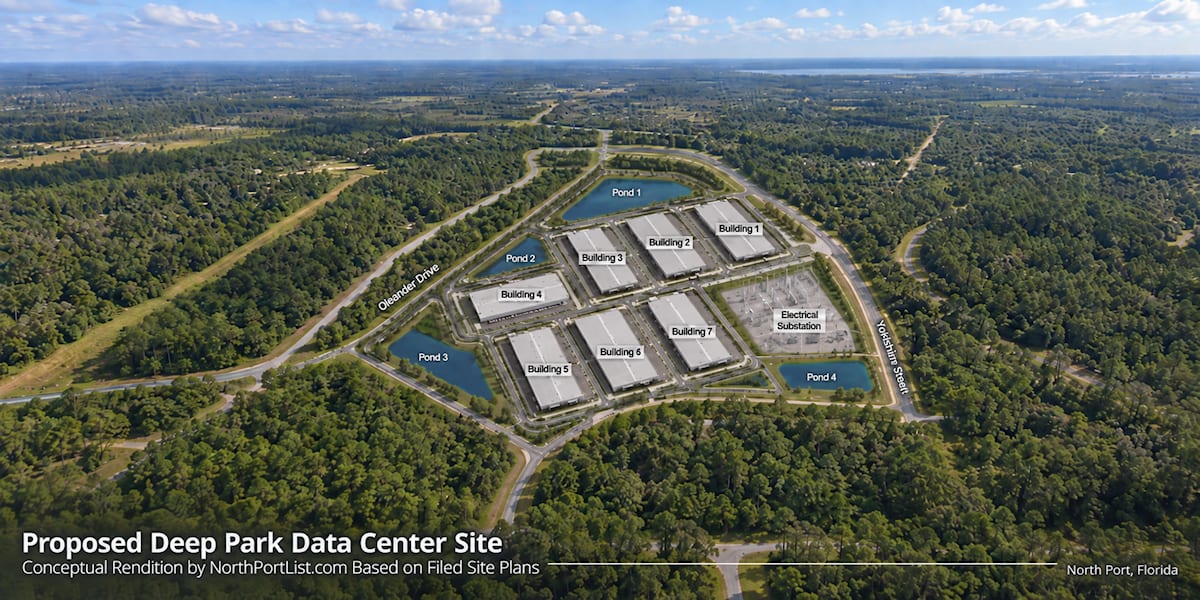
Aerial rendering of the proposed Deep Park Data Center site in North Port, Florida, showing seven buildings, four retention ponds, an electrical substation, and surrounding roads

Conceptual rendering by NorthPortList.com based on filed site plans.

Bottom line

The Key Economic Conclusion

The proposed Deep Park Data Center can produce a major, multi-year construction project and a substantial temporary payroll. Its long-term direct workforce will be much smaller than its construction workforce. Based on the closest real-world hyperscale comparisons, a reasonable planning range for North Port is 1,000 to 1,300 workers physically on the site at peak construction and approximately 100 to 200 permanent direct positions after the campus is fully operating.

Those numbers are independent planning ranges, not commitments by the developer. The current Deep Park filings do not state a peak construction headcount, how many job-years, a phasing schedule, a permanent full-time-equivalent headcount, a local-hire target, wage ranges, or a project-specific workforce-training plan. Those missing items are important because employment has been presented in the application as a major project benefit.

The construction phase is the strongest employment and local-spending component. The operational phase offers fewer jobs, while many of those positions are skilled, technical, 24/7 mission-critical roles that can provide strong career opportunities.

Employment measureReasonable planning rangeWhat it means
Peak construction workforceAbout 1,000-1,300 on siteWorkers physically present during the busiest overlapping construction phases.
Full campus construction periodAbout 3-5 years if all seven buildings are builtWorkforce rises and falls by phase; individual trades are not employed for the entire period.
Permanent Data Center JobsAbout 100-200 positionsCentral planning range for a Data Center this size depends on power, operating model, automation, outsourcing, and functions placed on site.

Discrepancy in the record

A Filing Inconsistency That Should Be Reconciled

Importance ranking: 8/10 - The July 2026 Site Development Plan states that the project consists of seven data-center buildings totaling approximately 896,000 square feet, including approximately 123,200 square feet of office space. The construction plans also label each of the seven buildings at 128,000 square feet, which totals 896,000 square feet.

A separate July 20, 2026 transportation-impact letter analyzes up to 965,450 square feet of data center. The site-data sheet also lists 22.16 acres of building area. Converting 22.16 acres produces approximately 965,290 square feet, nearly matching the transportation figure.

The filings do not explain what accounts for the additional 69,450 square feet, a difference of about 7.8% from the 896,000-square-foot figure.

Square footage matters because it is used in transportation analysis and staffing models that rely on building size. The applicant or City should reconcile the definitions and identify which figure represents gross building area for the approved project.


Construction employment

How Many Construction Workers Would the North Port Data Center Employ?

The closest real-world Data Center comparison is Meta's Temple, Texas data center. Meta originally described Temple as nearly 900,000 square feet and projected more than 1,200 workers on site at peak construction. When the data center facility went online in July 2026, Meta reported that construction had supported about 1,200 skilled-trade workers at peak and that the site employs almost 100 operational roles.

Meta also reports similar peak construction tradesmen at several other large campuses: 1,200 at Fort Worth, 1,000 or more at Beaver Dam and Cheyenne, and 1,500 at Henrico.

Table comparing Meta data centers in Temple TX, Beaver Dam WI, Cheyenne WY, Fort Worth TX, and Henrico VA by size, peak construction workforce, and operational employment, against the proposed North Port Data Center

Peak construction workforce and operational employment at comparable Meta data centers, compared with the proposed North Port Data Center.

For Deep Park's 896,000-square-foot seven-building plan, about 1,000 to 1,300 workers is the most likely range. The peak can move higher if several major buildings and infrastructure packages are intentionally overlapped, or lower if the campus is built sequentially.

How Long Would the Construction Employment Last?

For the complete seven-building campus, approximately three to five years is a practical planning range if the project is fully built and phased in a manner comparable to other hyperscale campuses. Meta's Temple facility broke ground in 2022 and began operating in 2026.

There is also a three-building hyperscale campus of more than 900,000 square feet being developed in the Phoenix area over a five-year period.

That does not mean 1,000 to 1,300 workers remain on site for three to five years. Construction employment occurs in waves. Sitework and civil crews arrive early; structural, electrical, mechanical, fire-protection, controls, fiber, security, testing, and commissioning crews peak at different times. Some workers may be assigned for weeks or months, while core management and specialized trade crews can remain for a year or longer. The Deep Park developer has not published its construction phasing or manpower schedule, so the actual duration remains a project variable.

A data center of North Port's proposed scale can support additional jobs throughout the broader economy during construction through supply-chain activity and worker spending. The Deep Park developer has not published a project-specific estimate for those secondary jobs. Based on comparable hyperscale projects, about 1,000 to 1,300 workers physically on the construction site at peak remains the more useful estimate for direct on-site employment. If the developer later publishes an economic-impact study, the report should separate peak on-site workers, direct job-years, indirect supply-chain jobs, and induced jobs supported by worker and business spending.

Local Workforce Considerations if the Project Moves Forward

If Deep Park moves forward, an important economic question is how much of the construction and permanent employment will be filled by North Port and regional workers. The City could seek specific local-hiring, apprenticeship, and subcontracting commitments if those commitments are legally and contractually available. Those commitments would increase the share of project payroll and contractor spending retained in the local economy. No project-specific local-hire or subcontracting commitment is documented in the filings reviewed.


Regional labor market

North Port Has a Large Construction Workforce — Mission-Critical Skills Are Narrower

The U.S. Bureau of Labor Statistics reports 20,990 construction and extraction jobs in the North Port-Bradenton-Sarasota metropolitan area in May 2025. The metropolitan area includes Sarasota and Manatee counties, so this is a regional labor-market figure not a North Port specific count.

Regional construction occupationEmploymentMean hourly wage
Construction and extraction, all20,990$26.79
Construction laborers4,260$22.12
First-line construction supervisors2,950$39.03
Electricians1,620$26.70
Plumbers, pipefitters and steamfitters1,390$27.68
Carpenters1,870$26.18
Operating engineers / equipment operators1,090$25.29

This regional base means Deep Park would not be starting from zero. Local contractors and workers can fill many civil, concrete, carpentry, electrical, plumbing, mechanical, roofing, equipment-operation, landscaping, and supervisory needs. Mission-critical data centers also require specialized experience with high-reliability electrical distribution, UPS systems, generators, switchgear, building-management and electrical-power-monitoring systems, controls, high-density cooling, commissioning, and strict operating procedures. Those narrower skills are less common than general construction skills.


During construction

Economic Benefits for North Port During Construction

The construction phase can create substantial economic activity in North Port and the surrounding region. The strongest benefits are payroll, contractor revenue, local purchasing, and spending by traveling and local workers.

Economic benefitWhat North Port and the region can gain
Construction payrollWages and overtime for civil, structural, electrical, mechanical, HVAC, controls, fire-protection, fiber, security, testing, and commissioning crews.
Local and regional subcontractingRevenue for excavation, grading, concrete, paving, trucking, landscaping, equipment rental, waste services, specialty trades, and construction support.
Materials and servicesPurchases of concrete, aggregate, pipe, conduit, fuel, consumables, equipment service, hauling, and other locally available inputs.
Restaurants, retail and fuelDaily spending by workers throughout a multi-year construction period.
Hotels and temporary housingDemand generated by specialized crews, supervisors, commissioning teams, and vendor technicians brought in from outside the area.
Professional servicesEngineering, surveying, inspection, environmental work, geotechnical and materials testing, legal, accounting, permitting, and construction management.
Training and apprenticeshipsAdditional demand for electricians, HVAC/R workers, controls technicians, and other skilled trades can support apprenticeship and technical-training.
Government and utility revenuePermit, inspection, connection, service, and other applicable revenues depend on the final project structure, agreements, and tax treatment.
IndirectSuppliers and contractors purchase goods and services, and workers spend portions of their wages in the regional economy.

Not All of the Investment Stays in North Port

Much of the value in equipment and infrastructure are manufactured outside North Port and Sarasota County. The local benefit depends mainly on local hiring, subcontracting, purchases, and worker spending. Based on the location, Port Charlotte and Charlotte County would also receive restaurant, retail, lodging, and other spending from workers on the project.

Economic Benefit

Deep Park has not published a capital-investment figure, taxable value, local-hire percentage, local subcontracting share, or project-specific incentive request, so any range remains a planning range.

Construction payroll: An early range is $75 million to $225 million over a three-to-five-year full-campus buildout. The previously estimated range of 1,000 to 1,300 workers represents peak on-site employment during the busiest construction phases, not the workforce maintained throughout the entire project. Construction staffing would rise and fall as different trades enter and leave the site. An average on-site workforce of roughly 450 to 700 workers across the full construction period is consistent with a project that reaches 1,000 to 1,300 workers only at peak.

The payroll uses the region's $26.79 mean hourly construction wage as a starting point, with higher pay and overtime for specialized mission-critical trades at the upper end. This is total project payroll, not money that would all remain in North Port.


After construction ends

Permanent Employment: Smaller Headcount, More Specialized Roles

Once construction ends, a hyperscale data center operates with a much smaller workforce.

Meta's nearly 900,000-square-foot Temple project is an especially close physical comparison and currently supports 100 operational roles. Square footage alone is not a reliable staffing formula but it is a benchmark based on other Data Centers.

What Could the Permanent Workforce Mix Look Like?

A planning model would use ranges rather than a fixed headcount. The common characteristic is an experienced technical core supported by a smaller developing workforce and a small management layer.

In a 100-person operation, the model would produce about 25 junior employees, 60 experienced techs, and 15 senior managers; at 200 employees, the same profile would be about 50, 120, and 30.

What Qualifications Do Data-Center Employees Need?

Current Amazon Web Services engineering-operations job postings show that a high-school diploma plus electrical, mechanical, mission-critical, military, trade-school, HVAC, or related experience can satisfy basic qualifications. Data-center experience is often preferred.

For IT and hardware technicians, CompTIA A+, Network+, Server+, Cisco CCNA, and similar credentials can improve competitiveness, especially for candidates without direct data-center experience. Employers can accept equivalent hands-on experience. For critical facilities work, electrical, HVAC/R, controls, generators, UPS, switchgear, BMS/EPMS, and safety experience can be more directly relevant than a general IT degree.

Pay, Overtime and Benefits

The permanent jobs can pay well. A North Port-specific pay scale cannot be stated yet because the operator, which likely is not the developer, has not posted Deep Park jobs or disclosed wage bands. Current major-operator postings show how wide the market can be: one current AWS (Amazon Web Services) operations technician posting in Virginia lists $32 to $57 per hour and accepts a high-school diploma plus qualifying mission-critical, electrical, or mechanical experience.

At $32 per hour, 2,080 straight-time hours equal $66,560 per year. If overtime is paid at time-and-a-half, the overtime rate is $48 per hour.

Twenty-four-hour operations make nights, weekends, rotating schedules, on-call coverage, and 12-hour shifts common or acceptable in the industry.

Some large technology operators offer strong health coverage, retirement matching, paid leave, bonuses, equity, tuition support, certification funding, and career-development programs. Those packages vary by employer and role.

The Industry Is Already Expanding Training

The growth of AI and hyperscale data centers is pushing the industry to train new workers rather than relying only on experienced hires from other facilities. That expansion is already underway.

  • AWS (Amazon Web Services) operates a 12-month paid Work-Based Learning Program that combines instruction and on-the-job training for data-center operations and related roles. Participants who meet the program requirements can move into data-center positions.
  • Meta launched America's Workforce Academy in 2026 with an initial $115 million first-year investment. The program is free, provides an NCCER credential, and guarantees a job for graduates. The 2026 pilot locations are Louisiana, Ohio, Indiana, and Texas.
  • Google.org committed $50 million in 2026 to union- and contractor-supported skilled-trades training programs to expand training capacity.

Can North Port Residents Prepare for These Jobs Now?

Yes. North Port and the surrounding region already have training programs that provide feeder skills. Suncoast Technical College, State College of Florida, and Charlotte Technical College in Port Charlotte offer related courses but they are not a dedicated Deep Park mission-critical operations curriculum, and the developer has not announced a local training partnership for this project.

Without an early local training and apprenticeship pipeline, the data center operator will have to recruit outside the immediate area for at least some experienced and senior operational roles. Those workers would relocate to the North Port/Sarasota area or commute from elsewhere. Local candidates can improve their position by beginning electrical, HVAC/R, controls, networking, server-hardware, industrial-safety, and mission-critical training before the facility opens.


Working conditions

On the Job Noise:

Hearing protection depends on exposure rather than a server-floor rule. OSHA requires a hearing-conservation program where an employee's eight-hours exposure reaches 85 dBA, and the general-industry eight-hour permissible exposure level is 90 dBA. Loud mechanical, generator, or server areas can be designated hearing-protection zones, while other areas may not require continuous hearing PPE.


Open questions

Information North Port Could Request From the Data Center Applicant

Is employment planned as a public benefit of the project? If employment is presented as a public benefit of the project, City officials should request a clear employment schedule and information about local hiring before evaluating city concessions. The most useful disclosures would be:

  • Peak workers physically on the construction site.
  • Construction job-years and the expected construction start-to-completion period.
  • Building phasing and the expected overlap between major construction packages.
  • Permanent direct full-time-equivalent positions at initial opening and at full campus buildout.
  • The number of contracted or outsourced security, maintenance, janitorial, landscaping, and support positions.
  • Expected pay range and benefits for major occupational groups.
  • A local-hire headcount, or expected local-hire percentage.
  • Expected local and regional subcontractor spending.
  • Apprenticeship, technical-school, community-college, veteran, and workforce-development partnerships.
  • A reconciliation of the 896,000-square-foot and 965,450-square-foot figures used in current filings.

Publishing those numbers would allow North Port residents to separate the project's real construction opportunity from its much smaller permanent headcount and to measure how much of the economic activity is expected to remain in the local area to benefit local residents.

The largest direct employment effect is construction. A secondary benefit could be skilled-trades development and expansion of the local technical workforce. The long-term direct employment case should be measured with a developer-provided staffing plan rather than inferred from building size alone.